
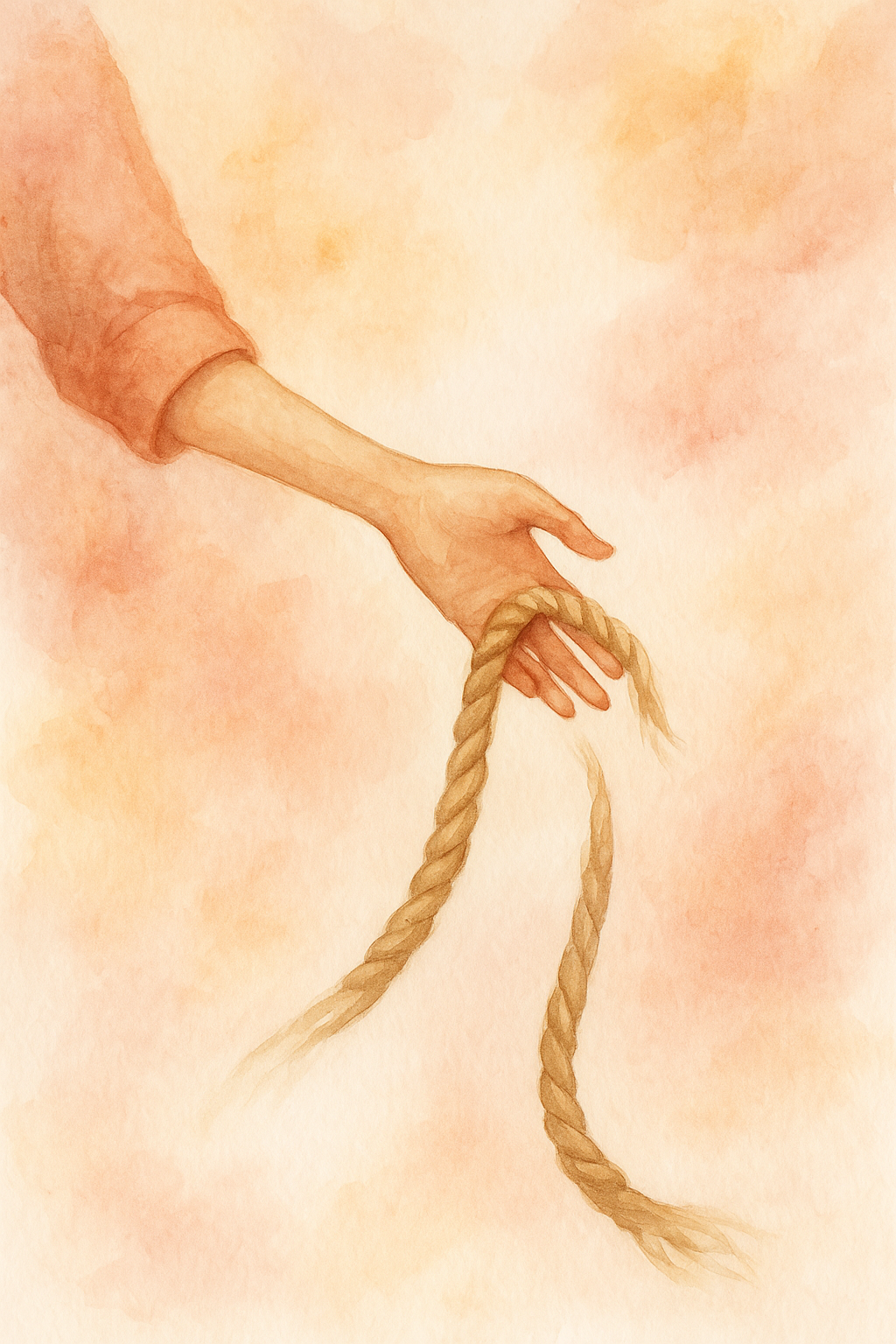
I once heard someone say the secret to winning tug-of-war is simple:
Let go of the rope.
At first it sounded ridiculous. But the more I thought about it, the more it made perfect sense. When you let go, the other team falls, there’s nothing left to pull against, and most importantly—you can’t get dragged into the mud.
When you’re focused on winning, your eyes stay glued on the other team.
You end up in a battle of stamina and ego: two forces pulling with everything they’ve got, but nobody actually making any progress.
But if your goal is simply not falling into the mud yourself, the answer becomes painfully obvious:
Let go.
I didn’t truly understand this until my divorce—and more specifically, the aftermath with my children. Full of malicious lies their dad had them emotionally investing in every argument, every accusation, every dramatic turn. And there I was, pulling with all my strength, trying to protect them from the very rope they were already clutching.
The more I pulled back, the tighter they held on—to him, to his version of the story, to their compassion for him as the wronged heartbroken husband.
The divorce itself dragged on longer than it should have. The spousal support was supposed to be straightforward. Line up the incomes and do the math, simple. Instead, it became a circus: he quit his job, claimed poverty, worked under the table, and even brought our daughter to a spousal support trial. Who does that to their child?
A trial that was supposed to be two days stretched into a full week. In the end, the judge saw right through him and deemed him “not a credible witness.” Support was awarded based on what he should’ve been earning… a momentary victory. Because he never paid a single dollar.
And I was left with a painful question:
Do I keep bleeding money to fight for money I’ll never see?
And what is this endless tug-of-war doing to my children?
Letting go wasn’t some enlightened, graceful realization. At first, it felt like failure. When I finally loosened my grip, I didn’t feel victorious — I felt empty-handed. It felt like he got away with everything and I ended up with nothing. He got the town we lived in. He got the house. He got the kids. He kept his life intact. I walked away without a home, without security, and without any idea who I was anymore. Worst of all, without justice.
Everyone could see he was lying, manipulating, performing. Even the judge. But no one could stop it. Not even the law. That kind of injustice lives in a deep place of helplessness.
And part of the reason I held on so long was this:
I didn’t want to feel like a victim again.
After years of swallowing every disappointment to keep the peace, fighting back felt necessary. Like reclaiming my voice, my self-respect.
But then came the moment—the shift I didn’t see coming.
The moment where love outweighed pride… where motherhood outweighed the urge to win.
I realized my biggest motivator for letting go wasn’t justice. It was them.
As long as I was holding that rope, they were stuck in the middle.
As long as I kept pulling back, he had something to pull against.
And the uglier things got, the more he used them as leverage.
Letting go meant he had no one left to fight.
No audience.
No opponent.
No rope.
Without me as his outlet, he had to show up in life as exactly who he is: angry, bitter, obsessed. That ugliness is becoming visible without me standing there as his excuse.
So I let it drop.
I fired my attorney.
I stopped responding to bait.
I stopped explaining myself.
I stopped trying to tug my kids away from his lies.
Letting go was absolutely what I needed for my own peace — but the truth is, I did it for them. I couldn’t let this battle stretch out into years and pretend I wasn’t part of the damage. Staying in the fight would’ve made me no better than him.
I walked away with no money, no safety net, and no idea what the future held.
But I also walked away with something far more valuable:
No drama. No debt. No chaos. No looking back.
My relationship with my children still isn’t repaired. The lies run deep, and they are still tangled in the fog of manipulation. But I can sleep at night knowing this: I didn’t drag them into the mud with me. I didn’t weaponize them. I didn’t make them carry the stories that belonged to adults.
I can look in the mirror and know the truth.
I let go of the rope.
And in doing so, I saved myself — and I gave my children the only chance they had to eventually save themselves too.
Leave a Reply