
Reclaiming confidence when your experience doesn’t look impressive on paper.
I’ll tell you right now: I don’t look good on paper.
I’ve been married three times.
Two of my three children don’t speak to me.
I worked as a secretary at a legal office for a few years. I worked for my mom for about a year. I did a very short, two-month stint as an aide in a special education department at an elementary school. I quit because I couldn’t handle it. I worked nine months at a nonprofit and three years for friends who owned a body shop and used car lot. I spent twenty-four years of my life as a non-working stay-at-home wife and mother.
Like I said, not good on paper.
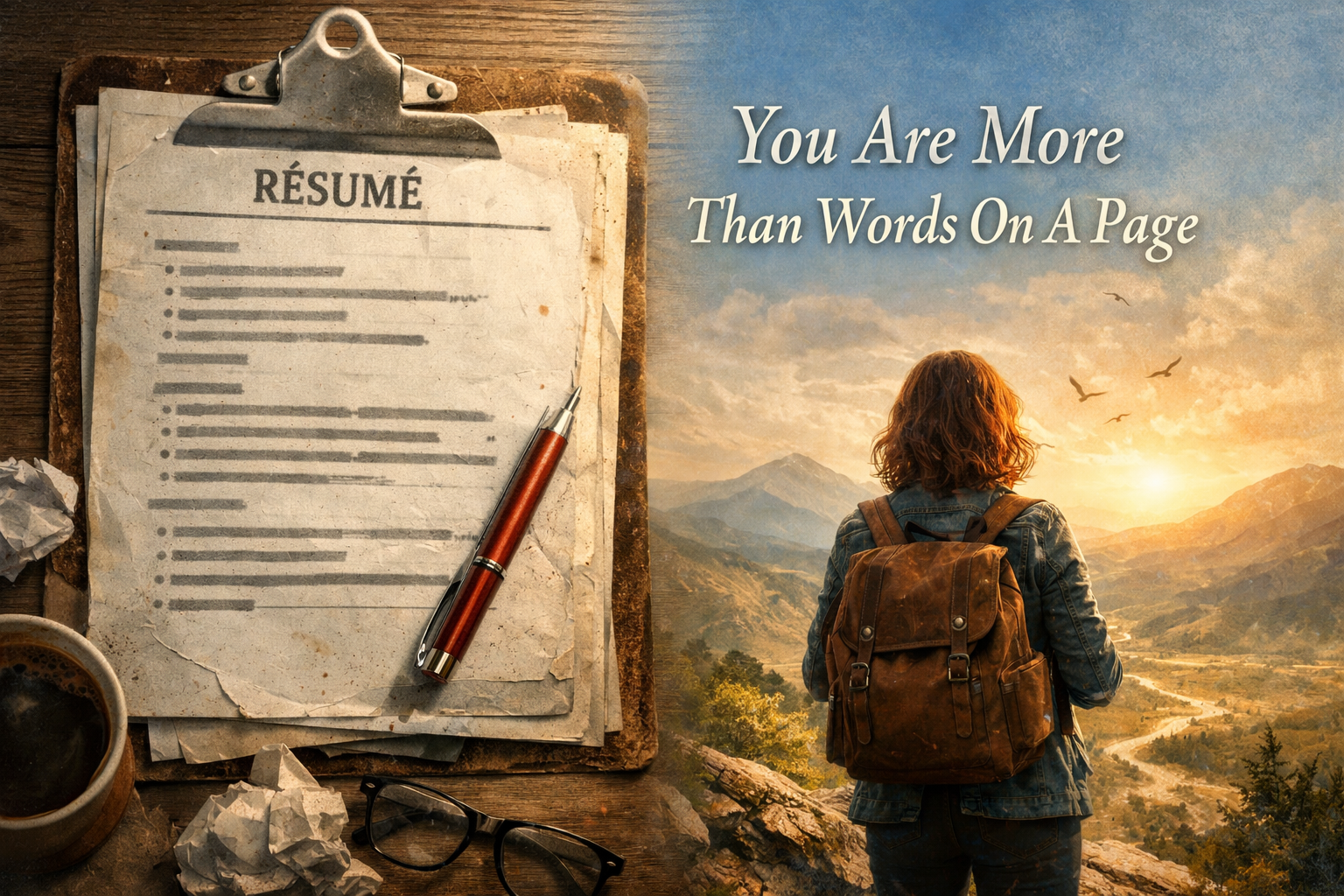
But I am not words on a page.
My experience, talents, and strengths are not given nearly enough weight or value in those few sentences. After years in a relationship where I was constantly told I wasn’t good enough, smart enough, or hardworking enough, it took time to believe I had anything meaningful to offer the world.
What I eventually realized is this: every job taught me something exponential about the world and about myself.
As a secretary in a small law office without a paralegal, I learned to do paralegal work. I gained a working knowledge of family law and personal injury law. I discovered I had a real strength for organization. Documents couldn’t be misplaced. Everything had to be meticulously documented and filed so it could be accessed quickly and efficiently. I also learned that I love typing. There’s something deeply satisfying about the rhythm of a keyboard. That love eventually fed my writing, my Substack, and the book I’m working on now.
Working for my mom in her interior design business taught me that I have a strong eye for color. I can see a shade once and remember it almost exactly, which isn’t common when you consider how many variations of color exist. I learned how to work with difficult clients, how to order custom items, and how to prepare people for worst-case scenarios. I learned to paint clean lines and sharp corners. I learned about deadlines, project management, communication, and again, how valuable my organizational skills really were.
To become a school aide, I had to pass a test that was seventy-five percent math. I’ve never been strong in math. But I studied. I practiced. Every red check mark taught me something. I learned that failing wasn’t failing. It was learning. I learned I could figure out anything I committed to. I also learned something equally important: just because I’m good at something doesn’t mean it belongs in my life. The school system didn’t light me up. I was proud of myself for recognizing that early and not sacrificing years doing something that drained me simply because it was available and paid well.
The three years I spent at the auto body shop and used car lot taught me the most. I got that job during my divorce, when my self-esteem was at its lowest. I started doing data entry a few hours a week. Within a couple of years, I was running the car lot as general manager. I learned that I can learn anything, but I also realized I possess skills that can’t be taught. I’m good with people. I make them feel comfortable and heard. I listen well. I thrive in fast-paced environments and enjoy being challenged. I learned sales, finance, and how to help people secure car loans even with bad credit. My confidence grew there. I never wanted to sell cars forever, but that job was a gift, and I’ll always be grateful for it.
Working at the nonprofit was one of the most enjoyable roles I’ve had. I handled email outreach for fundraising, researched contacts on LinkedIn, and helped secure donations of goods and services for large-scale events. One event hosted over five hundred people. The logistics fascinated me. Organization and documentation were essential. That was my first real taste of the corporate world, and I thrived in it.
But the role that taught me the most was my twenty-four years as a stay-at-home wife and mother.
Anyone who thinks women sit around watching daytime TV and eating bonbons has no idea what they’re talking about. From those years, I gained time management skills, conflict resolution skills, scheduling expertise, relationship-building ability, communication and listening skills, project management experience, problem-solving instincts, and the ability to work with difficult people. I learned how to advocate for myself, how to navigate toxic environments, and how to survive under pressure. And that’s just scratching the surface.
The truth is, not looking good on paper does not mean you lack valuable, sought-after skills. Many of those skills translate beautifully into the business world. You just have to identify your strengths and build on them. Everything is a learning experience. Even discovering what you don’t like or don’t want is progress. Nothing is wasted.
I once heard a ex-NFL player talk about approaching every job as if you’re being paid a million dollars to do it. After an injury ended his career, he found himself with no degree and no obvious skills outside football. He took a job mopping floors at a grocery store at night. He mopped like it mattered. Like he was being paid a million dollars. People noticed. He earned respect. His confidence returned. Eventually, he became a successful radio personality.
He credits his success to taking pride in every task, no matter how small, and building relationships rooted in respect for himself and others.
That story stayed with me.
I try to work hard at whatever I’m doing. I try to learn. I try to build relationships. And I keep moving forward with everything I’ve learned packed neatly into my backpack of skills, experience, and resilience.
And here’s the part I’m still learning: I’m allowed to dream bigger than my résumé suggests. I’m allowed to give myself credit for the things that don’t fit neatly into bullet points. The truth is, the world will always have skeptics. People will judge, minimize, misunderstand. That’s unavoidable. What is avoidable is becoming one of them. I refuse to be my own critic, my own gatekeeper, my own reason for staying small. I’ve earned the right to believe in myself. I’ve worked for it. And from here on out, I choose to move forward with confidence, curiosity, and the quiet understanding that my life has prepared me for more than I can even see yet.
So let me ask you this: how do you look on paper? And more importantly, how much of you is missing from it? What skills did you earn in the invisible years? What strength, resilience, and wisdom never made it onto a résumé? Don’t let a piece of paper decide your worth. Don’t be one of your own haters.
You are more than words on a page.
Leave a Reply