
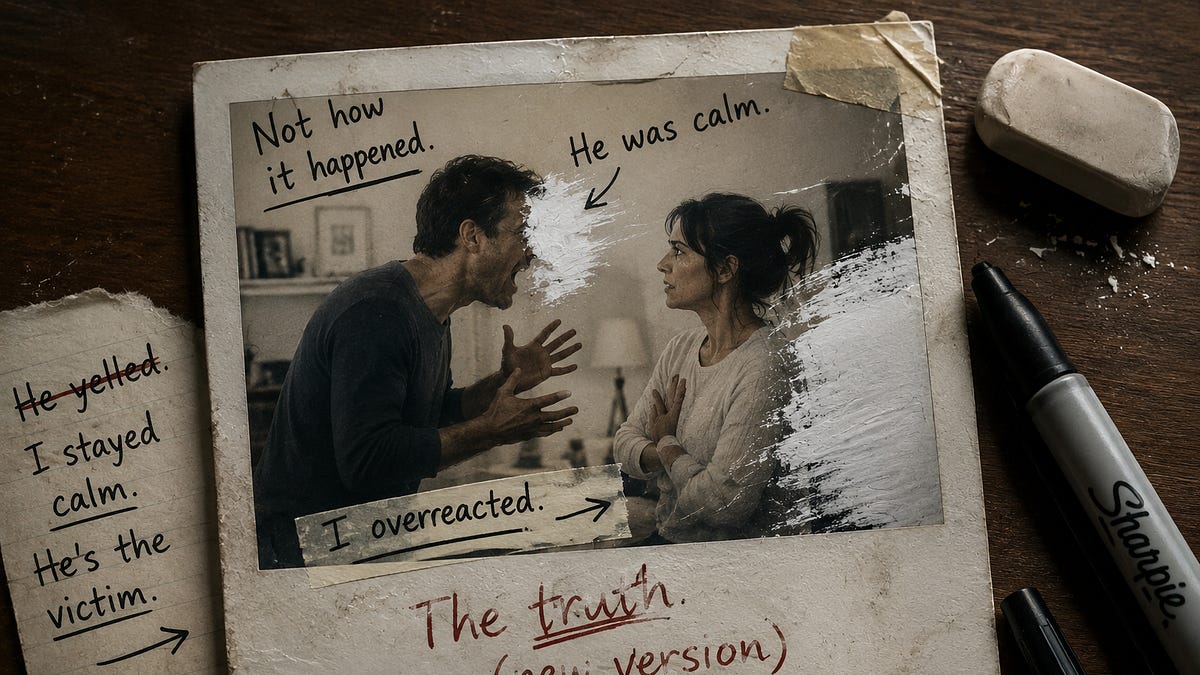
“I need to tell you something,” he said. “About the affair. I didn’t actually do it. I just said that. I don’t even know why.”
I stood there holding the phone, waiting for the punchline. There wasn’t one.
Weeks earlier, he’d confessed. Cried about it, even. Gave me details — specific, intimate ones. The kind you don’t just make up on the spot. Now the confession itself was up for revision, like a rough draft he’d decided to rewrite after the fact, and I was just supposed to accept the new edition.
What the heck is this? I actually laughed. Not because it was funny. Because I was completely dumbfounded by how convinced he sounded. This wasn’t someone testing a lie to see if it would stick. He believed this new version. Or needed to so badly that it didn’t matter whether it was true.
That’s when it clicked. He wasn’t just denying things. He was rewriting them.
Wait… That’s Not What Happened
Gaslighting Part 1 was about denial — that never happened, you’re remembering it wrong. This is the next level up.
Rewriting history isn’t just erasing a memory. It’s replacing it with a new one, and expecting you to move in.
What gets me most is how convinced they sound doing it. It’s not a defense tossed out to get through a fight. They say it with the same flat certainty you’d use to state your own name.
“I didn’t get mad and yell at you in front of everyone. I pulled you aside and tried to calmly reason with you.”
“I didn’t give you the silent treatment for a week. I was just busy — you know I had a rough week, I just didn’t have the energy to argue with you.”
Suddenly the fight you had wasn’t about his behavior — it was about your overreaction. The years you spent holding things together weren’t sacrifice — they were you being controlling. The version of events you lived through gets quietly swapped out for a new one where you’re the villain, and you’re supposed to just… go along with the remodel.
Did That Ring a Few Bells?
Rewriting history tends to sound like:
- “You always twist my words.” Or, “You’re always turning things around.”
- “That’s not how I acted — you were the angry one.”
- “You’ve made me out to be the bad guy this whole time.”
- A story about you, told with total confidence to other people, packed with details and exaggerations that seem to attack your very character
- Feeling like you need to keep a mental transcript of your own life just to stay sane
The scariest part isn’t that they lie. It’s how sure they sound while they’re doing it. Confidence isn’t the same thing as truth, but it’s very good at impersonating it.
If any of this sounds like where you are right now, The Safe Space is a good place to go for support.
The Four Words That Changed Everything For Me
I spent a long time trying to correct the record. Pulling up old texts. Reminding him what he’d actually said, what actually happened, hoping the facts would finally land.
They never did. Because it was never about the facts.
What finally worked wasn’t a longer explanation. It was shorter.
“Stop rewriting history. I was there. I know what actually happened.”
That’s it. No debate. No evidence packet. Just a flat, calm refusal to let someone else’s version override my own memory.
You don’t have to win the argument. You just have to stop entering it.
It’s Not a Court Case (Even Though It Feels Like One)
Talking to someone like this starts to feel a lot like building a court case. They’ll cross-examine every detail — the exact wording, the exact time, one small inconsistency — hoping to get your whole story thrown out. Ruled inadmissible.
That’s because they were never looking for the truth. They’re looking for a technicality. They’re not trying to figure out what actually happened. They’re trying to win on the letter of the law, so to speak, instead of the facts of the case.
Here’s what took me too long to learn: you don’t need a verdict. You don’t need them to admit to anything for it to be true.
You Don’t Need Their Signature
A rewritten history only works if you agree to read it.
You were there. You know what actually happened — the version with all the details they’d rather you forget, the ones that don’t fit the new story. That knowledge doesn’t need their approval to be true.
Part 3 goes deep on maybe the strangest part of this whole thing — the moment you find yourself defending your own behavior, explaining yourself, apologizing… when you were the one who got hurt in the first place.
If this is showing up alongside isolation, threats, or fear for your safety, this article isn’t a substitute for professional support. The National Domestic Violence Hotline (1-800-799-7233, thehotline.org) is free, confidential, and available 24/7.
Missed Part 1? Start there.

Leave a Reply